Monday, April 19, 2010

Media Awareness


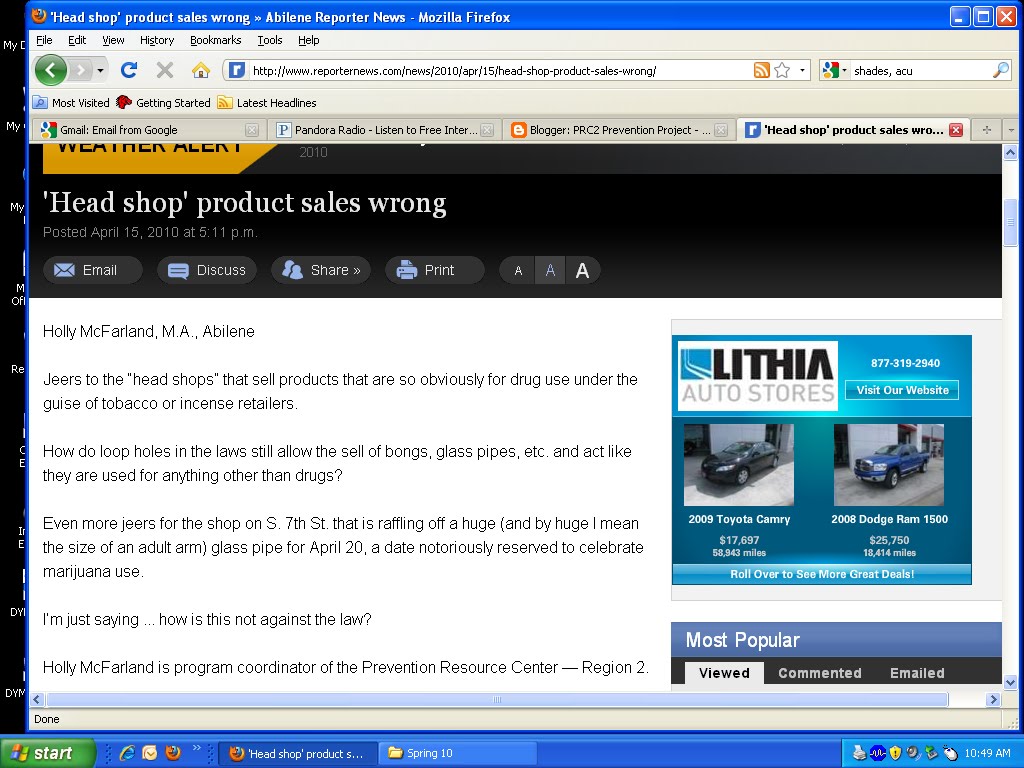
Letter to the editor, Abilene Reporter News, sparked some interesting conversation at ARN online.

At Austin Elementary for Tobacco Free Kids Day, KTXS coverage.

Booths


Sporting the new Staff shirts


Mini-booth with Red Carpet theme at the PRC Spring Meeting in Austin. These meetings give the 11 PRCs in Texas a chance to see what's going on in each others' regions, talk about drug trends, effective prevention strategies, legislation updates, etc.

What's happening?


Working hard...always

Tobacco Free Kids Day in Hamlin - The students did a 1200 project, posting these healthy and diseased lungs all over the school to represent the 1200 people who die everyday in the U.S. because of Tobacco.

Tuesday, April 6, 2010

Work Hard...Play Hard


10 Thoughts on Raising Resilient Kids.

To help our kids succeed, we must foster our kids' resilience by helping them learn to deal competently and successfully with the challenges of everyday life.
Here are ten fundamental guideposts along the path to developing your kids' resilience.
1. Be empathic. Recognize your children's point of view and acknowledge their feelings. You don't have to agree with everything they do or say, but try to appreciate and validate their viewpoint. When they know you're listening, they're more likely to look to you for guidance.
2. Communicate effectively and listen actively. Effective communication involves actively listening to your children, understanding what they are attempting to say and responding in ways that avoid power struggles. Help your children to understand your point of view and make a sincere effort to understand theirs.
3. Break free of negative scripts. If something you've said or done for a reasonable amount of time isn't working, think about what you can do differently. This teaches your children that there are alternative ways of solving problems and that you can learn from your mistakes.
4. Love your children in ways that help them to feel special and appreciated. Once children understand that you love them for who they are – and not simply for what they do or don't do – they develop the confidence to think for themselves and can be less susceptible to peer pressure.
5. Accept your children for who they are. One of the most difficult struggles as a parent is to accept your children as unique individuals. When this acceptance is present, you can successfully set expectations and goals consistent with your child's temperament.
6. Help your children find their islands of
competence. Let your children experience success by identifying and reinforcing those things they do especially well. Helping your children find their strengths will allow them to more easily accept and work on their weaknesses.
7. Help your children to recognize that we all learn from mistakes. Resilient children tend to view mistakes as opportunities for learning. In contrast, children who are not very hopeful often experience mistakes as an indication that they are failures. Helping your children to see life as a continuous learning process takes the fear out of trying new experiences.
8. Provide children with opportunities to contribute. Help your children develop a sense of responsibility and enhance their self-worth by providing them with opportunities to help others.
9. Teach your children to solve problems and make decisions. Help your children learn how to make decisions and to solve problems independently. Resilient children are able to define problems, consider different solutions and learn from the outcome.
10. Discipline your children in a manner that promotes self-discipline and self-worth. The ultimate goal is to nurture self-discipline so that your children act responsibly even when you're not around. Whenever possible, help your children understand the value in the lessons you teach them.

Alcohol Awareness Month


Drunk driving is never a good idea...

Thursday, March 4, 2010

Kick Butts Day


March 24th is Texas Tobacco Free Kids Day! or Kick Butts Day, as some call it. Get a tobacco prevention activity organized for your school and you could win a scholarship to the Texas Teen Tobacco Summit at the Woodlands Resort (near Houston) this summer.
http://www.txssc.txstate.edu/SI/tobacco-conf

Tuesday, February 2, 2010

Drug Trends


Wanted you all to be aware of some recent Drug Trends in TX. Also, don't forget to wear Red this Friday February 5th to support Heart Disease prevention for women (Heart disease is top killer for tobacco users)! See post below.


“Liquid O” is Heroin mixed with water put in a Visine bottle; a drop of the liquid is either snorted by nose or put in mouth and swallowed. Confirmed in an area of my region, huge issue!

Symptoms of the use of liquid heroin is constricted pupils, droopy eyelids, slow speech, slow reflexes, facial itching, dry mouth and lowered blood pressure.

"Lean", a popular drink originated from Houston Texas, you require the following for the original formula:

-Promethazine w/Codeine VC <- Sizzurp (active ingredient)
-Original Sprite Soda <- Mixing ingredient (although different flavors of sprite are now used, such as sprite remix)
-Jolly rancher candy <- Flavor additive

Put it all in a styrofoam cup and enjoy. The codeine is mainly responsible for the euphoric feeling after drinking lean. Promethazine causes motor skill impairment, lethargy, extreme drowsiness, as well as a disassociative feeling from all other parts of the body, specifically the stomach and digestive system. If it doesn't have promethazine w/ Codeine, it isn't real sizzurp.

The mixed drink combination known as "lean", is normally the color purple, due the added ingredient sizzurp, which is originally a dark purple syrup. There are other colors of sizzurp which can be added to create lean, but the purple is the true sizurp

There are drinks on the market now, in convenience and grocery stores meant to replicate the effects of "Lean." Some of these brands are Purple Drank, Slow Cow, Ex Chill, Malava Relax, all used to create the popular "slow your roll" feeling. Move over Red Bull...we're going the opposite direction now. You can imagine the side effects, slowed speech, slowed reactions, apathy, depression, etc.

Studies show continued escalation of Marijuana and prescription drug abuse among teens. Easier access with lesser penalties...prevention, intervention, parental involvement and law enforcement (even of tobacco and alcohol offenses) are the key.